
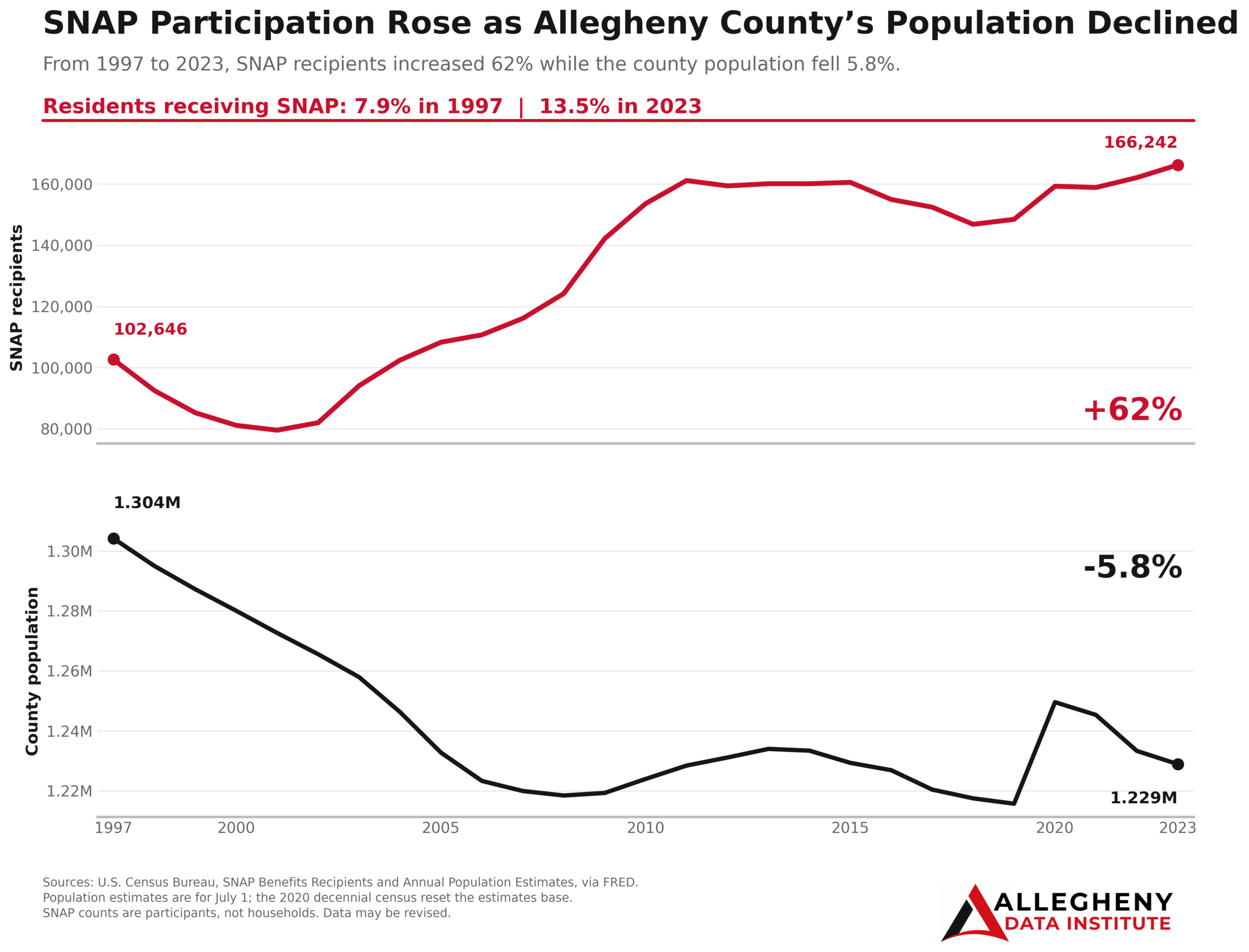
Key Finding: The number of Allegheny County residents receiving Supplemental Nutrition Assistance Program benefits, commonly called SNAP, increased substantially between 1997 and 2023. This increase occurred while the county’s total population declined.
In 1997, 102,646 county residents received SNAP benefits. By 2023, that number had reached 166,242—an increase of 62%.
During the same period, Allegheny County’s population decreased from approximately 1.30 million to 1.23 million residents, a decline of 5.8%.
What the Data Shows: In 1997, SNAP recipients represented approximately 7.9% of Allegheny County’s population. By 2023, the share had increased to 13.5%. This means that about one out of every eight county residents received SNAP benefits in 2023. In 1997, the figure was closer to one out of every thirteen residents.
The increase did not happen at a steady rate. SNAP participation fell during the late 1990s and reached its lowest point in 2001, when approximately 79,000 residents received benefits. Participation then rose sharply during the 2000s, particularly around the Great Recession. It began rising again before the COVID-19 pandemic and reached 166,242 in 2023, the highest level shown in this analysis.
Analysis: The two trends provide important context when viewed together. Allegheny County had about 75,000 fewer residents in 2023 than it did in 1997, but approximately 64,000 more residents received SNAP. The increase in both the number and percentage of residents receiving SNAP shows that food assistance has become more important to many Allegheny County households.
Federal changes enacted in 2025 expanded work and reporting requirements for certain SNAP recipients and changed eligibility for some groups. Pennsylvania estimated in July 2025 that 13,513 Allegheny County residents will lose SNAP assistance because of these changes.
This projected loss could be especially difficult for Allegheny County residents. The county already has fewer people than it did in the late 1990s, while a considerably larger number and share of its residents rely on SNAP. A loss of food assistance will place additional pressure on food banks, community organizations, families, and local governments.
Method: This analysis combines two annual U.S. Census Bureau series for Allegheny County:
- The number of people participating in SNAP.
- The county’s estimated resident population.
Both series were accessed through the Federal Reserve Bank of St. Louis FRED database.
The percentage of residents receiving SNAP was calculated by dividing the annual number of SNAP participants by the county population estimate for the same year.
The estimate of residents expected to lose SNAP was produced by the Commonwealth of Pennsylvania in July 2025 following the passage of the federal budget law commonly called HR 1.
Sources:
- U.S. Census Bureau, SNAP Benefits Recipients in Allegheny County, Pennsylvania, accessed through the Federal Reserve Bank of St. Louis.
- U.S. Census Bureau, Resident Population in Allegheny County, Pennsylvania, accessed through the Federal Reserve Bank of St. Louis.
- Commonwealth of Pennsylvania, Impacts of the Federal Budget Bill on Pennsylvanians.
- Pennsylvania Department of Human Services, Federal Changes to Benefits Programs.