
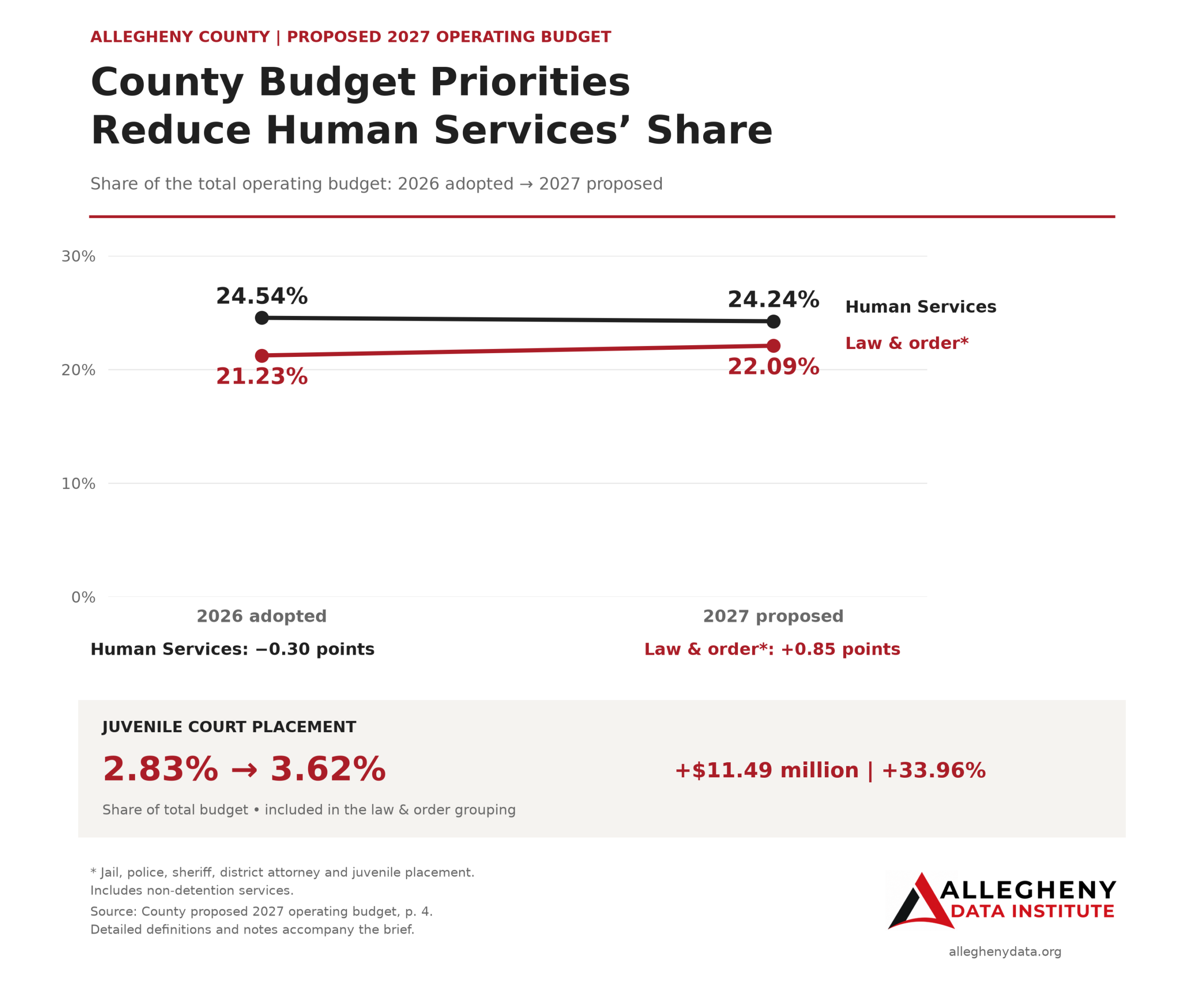
Key Finding: The proposed 2027 operating budget gives Human Services a smaller share of the total than in 2026, while a defined grouping of law enforcement, jail and juvenile placement spending gains share. Juvenile Court Placement accounts for most of that share shift.
What the Data Shows:
| Operating-budget allocation | 2026 adopted | 2027 proposed | Share of total, 2026 → 2027 |
|---|---|---|---|
| Human Services department (DHS) | $292.90 million | $303.08 million | 24.54% ↓ 24.24% |
| Law Enforcement, jail and juvenile placement grouping* | $253.40 million | $276.16 million | 21.23% ↑ 22.09% |
| Juvenile Court Placement, included in the grouping above | $33.83 million | $45.32 million | 2.83% ↑ 3.62% |
Juvenile Court Placement is included in the grouping above; the rows are not additive. [1]
Analysis: A larger appropriation in dollars does not necessarily mean a larger priority relative to the whole budget. DHS receives more dollars in 2027, but its share falls by 0.30 percentage points. The Law Enforcement, jail, and juvenile placement grouping above grew by 0.85 points. Without Juvenile Court Placement, the other four departments’ combined share moves only from 18.40% to 18.46%. The juvenile placement line is therefore central to this year’s shift. These are changes in proposed allocations, not proof of changes in services or outcomes. [1]
The county’s broader categories tell a different story: Health and Welfare and Public Safety both lose a small amount of share in 2027. DHS is one department within Health and Welfare; Juvenile Court Placement is also included there. Public Safety includes services such as public defense and emergency response. Calling all of Public Safety “law and order,” or all of Health and Welfare “prevention,” obscures those differences. [1]
What This Means for the Detention Debate: Juvenile Court Placement rises 33.96%. However, this department covers more than secure detention, and the budget does not isolate the full increase as the Shuman/Highland expansion. Its stated initiatives include securing additional detention beds and developing community-based alternatives. The relevant question is how the additional resources divide between those functions. [1]
The administration separately identifies $33 million in capital improvements for the juvenile detention center and cites residential placement costs among operating-budget pressures. That capital figure is excluded from this operating-budget analysis; adding it to the operating increase would mix distinct budgets. [4]
Budgets reveal how resources are allocated, but mandates, reimbursements, staffing costs and outside funding also influence those choices. The administration says part of the overall increase is due to the drawing down state DHS and juvenile probation funding. A larger gross appropriation is not necessarily an equally large increase in the county-funded contribution. [4]
Questions Community Members Can Raise
- How much of the juvenile placement increase funds secure detention, other residential placements, community alternatives, and changes in rates or staffing?
- What detention capacity, admissions and lengths of stay does the proposal assume? What evidence supports those assumptions?
- What funding and measurable goals support diversion and keeping children in their communities?
- How will the county report these outcomes by race, age, gender and neighborhood so residents can assess unequal impacts?
- How will DHS maintain access when its share of the operating budget falls?
These questions seek evidence about the proposal’s effects. The budget totals alone do not establish that more children will be detained, or that racial inequities will increase.
Definitions, Notes and Sources
ADI defines this grouping as Jail, Police, Sheriff, District Attorney and Juvenile Court Placement. It is the “law & order” grouping in the graphic, not an official county category. It excludes courts, Public Defender and Emergency Services. These rows overlap and must not be added together. [1]
This comparison concerns 2026 adopted versus proposed 2027 allocations. The latest one-year shift should not be described as a continuous trend across the administration’s tenure. [2, 3]
Shares equal each appropriation divided by the total operating budget for that year. The latest comparison uses the 2026 adopted baseline in the 2027 program-area summary, consistently avoiding the different adjusted-budget figures in individual department pages. Figures are nominal budget allocations, not actual expenditures. Separate capital, grants, special accounts and agency budgets are excluded; state and federal revenues already within the operating budget are retained.
- Allegheny County, 2027 proposed operating budget / Comprehensive Fiscal Plan, printed p. 4, program-area comparison; printed pp. 63–67 and 118–119, department descriptions and initiatives. Figures are from the PDF summary; the interactive dashboard has minor classification differences.
- Allegheny County, 2025 proposed Comprehensive Fiscal Plan, printed p. 6, 2024 adopted column only. The proposed 2025 amounts and out-year projections were not used.
- Allegheny County, 2024 adopted operating budget, cover, enactment date.
- County Executive, 2027 budget announcement, October 6, 2026.
Leave a Reply