


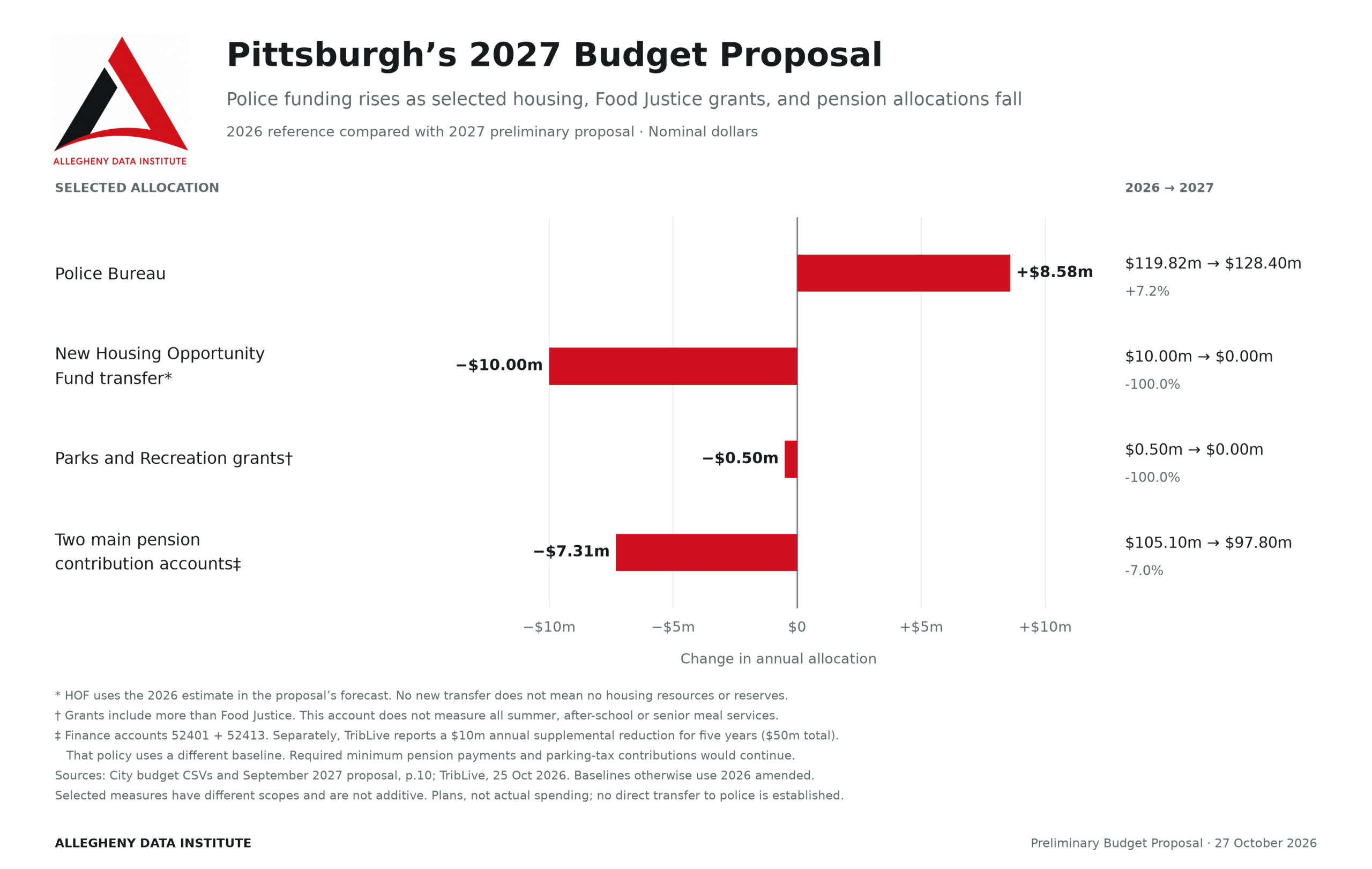
Police funding rises as housing, Food Justice grants, and pension allocations fall.
Key Finding: Pittsburgh’s preliminary 2027 budget raises the Police Bureau allocation while ending a new Housing Opportunity Fund (HOF) transfer, removing the Parks and Recreation grants allocation, and reducing two main pension contribution accounts. These choices warrant scrutiny of the continuity of housing and food assistance and the pace of pension funding. [1–3]
Analysis: The proposal shows no new HOF transfer for 2027–2031. The administration cites URA reserves as a reason service can continue. But URA’s September minutes distinguish available money from commitments, reporting lags and project backlogs. Ending recurring replenishment can constrain future assistance even when cash remains. Separately, OMB proposes $6.8 million for housing issuance, URA programming and the Land Bank. The extent to which these allocations replace HOF services remains unresolved. [1–3]
The Parks grants account falls from $3 million in 2025 to $500,000 in 2026 and zero in the 2027 proposal. Two named food-system positions also lose their funded lines. A pending 2026 Food Justice resolution proposes up to $250,000 in awards within the broader account. The program targets food access through community organizations. This is evidence of reduced new grant support, not proof that summer meals, after-school food or senior lunches end. Earlier awards may support activities during 2027. [1, 4, 5]
TribLive reports a proposed $10 million annual reduction for five years in supplemental pension contributions, from about $34 million to $24 million. Required minimum payments and parking-tax contributions would continue. The proposal therefore reduces contributions by $50 million against the stated five-year baseline; it does not suspend pension funding. Officials told TribLive they had not seen an actuarial assessment of the long-term effects. [8]
The archived budget accounts show a different comparison: Pension Contribution and Additional Pension Fund total $105.10 million in 2026 amended and $97.80 million in 2027 proposed, down $7.31 million. This year-to-year change across both accounts differs from the reported reduction in one funding stream. The City should reconcile the baselines and publish a restoration schedule and actuarial analysis. [1, 8]
Police Allocations and the Crime Context: The Police Bureau would receive $128.40 million, up 7.2 percent from the 2026 amended budget. Regular pay rises $9.58 million, premium pay falls $5.49 million and health insurance rises $2.22 million. [1] Homicides fell from 71 in 2022 to 42 in 2024 and a preliminary 35 in 2025, roughly half the 2022 peak. The latest year’s reported offenses moved differently: MCCA lists robberies falling from 468 to 440, but rape rising from 95 to 163 and aggravated assault from 930 to 948. These figures support a decline in lethal violence, not a blanket claim that every crime category fell. [6, 7]
Questions for Public Scrutiny: The comparison raises a question of funding durability: which commitments receive recurring appropriations, and which rely on expiring grants or accumulated balances? Before judging the service effects, the City should make HOF reserves net of commitments, replacement housing programs, food-service volumes and pension contribution changes comparable and traceable. This brief treats persistent austerity as a question to test through real service resources and outcomes.
Methods and Limitations: Budgets are plans, not actual spending. Dollars are nominal. Transfers, reserves and program expenses are distinct. No causal estimate links funding changes to crime or demographic outcomes. This brief is based on material checked through 26 October 2026.
Source Notes
1 City budgets 2026 amended and 2027 proposed — 2027 pp.10, 37, 55, 98–100, 134–137; ADI sums of archived CSVs. 2 Mayor’s budget explanation 30 September 2026 3 HOF Advisory Board minutes 1 September 2026 — pp.4–6; predates the mayoral proposal. 4 City Food Justice Fund program 5 City Council file 2026 1010 — Pending grant authorization; not evidence of completed payments. 6 Police 2024 Statistical Report — pp.3–4 and 49. 7 MCCA 2025 and 2024 year end survey — p.3; preliminary agency counts. 8 TribLive pension proposal explainer 25 October 2026 — Julia Burdelski; administration and pension officials interviewed.

